Oxford Strengthens Thames Cleanup, Global AI Governance, and Digital Scholarship Efforts
Oxford University expands its role in Thames restoration, global AI governance, and digital scholarship through research collaboration and OpenAI partnership.
 AnniWeston
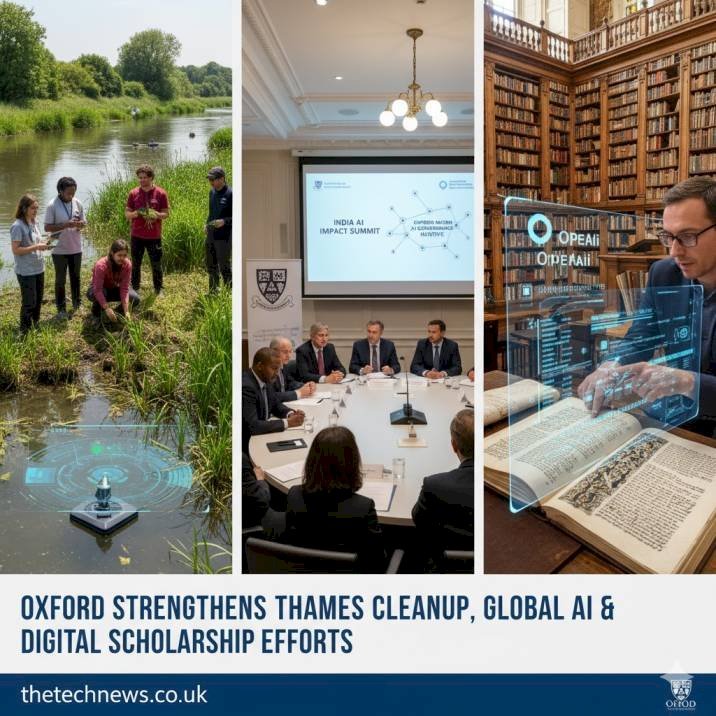
Oxford University's research and innovation community is embracing a broader role that spans local environmental restoration, international AI governance, and digital scholarship. These initiatives demonstrate how Oxford leverages science and technology expertise to influence public policy, sustainability, and knowledge preservation amid rapid global technological change.
Restoring the River Thames
The University, in collaboration with local environmental organizations and technology innovators, is actively supporting the cleanup and ecological restoration of the River Thames. Concerns about water pollution, sewage discharge, and declining biodiversity have galvanized renewed efforts involving scientific expertise and data-driven approaches.
Oxford researchers and associated science parks are deploying sensor-based water quality monitoring, real-time data analytics, and AI-driven modeling to identify pollution hotspots. Biological sciences teams are advancing wetland rehabilitation and bioremediation techniques, such as planting reeds and wetlands to naturally filter runoff and stabilize riverbanks. This shift from volunteer-driven cleanups to evidence-based interventions is enabling more sustainable ecological restoration.
Organizations like Thames21 coordinate multiple community science projects across Oxfordshire and London, involving volunteers monitoring bacteria levels, managing pollution data via digital portals, and advocating for infrastructure improvements to reduce sewage spills. For example, the designation of Port Meadow in Oxford as a bathing water site in 2022 exemplifies progress backed by citizen science and strategic partnerships, leading to better water quality monitoring and penalties for pollution infractions.
Oxford’s involvement is emblematic of how universities can directly contribute to local environmental sustainability through research, technology, and community engagement.
Leading Global AI Governance Dialogue
Oxford also occupies a prominent role in shaping the international discourse on AI governance. In November 2025, the Oxford Martin AI Governance Initiative hosted a pre-summit dialogue in New Delhi ahead of the India AI Impact Summit. This forum convened policymakers, academics, governance experts, and technology representatives to address responsible AI adoption, ethical regulation, transparency, and international cooperation.
India's status as a key AI stakeholder made New Delhi the ideal location to reinforce UK–India collaboration on AI governance. Oxford’s research in algorithmic fairness, risk assessment, and policy frameworks emphasizes the ethical integration of AI technologies, positioning the university as a policy mediator that bridges governments, industries, and research communities worldwide.
Advancing Digital Scholarship with OpenAI
In March 2025, Oxford and OpenAI announced a strategic partnership to revolutionize digital research by digitizing the Bodleian Libraries’ extensive collection. Using advanced AI technologies, the project focuses on scanning, transcribing, and making accessible rare manuscripts, maps, archival letters, and printed works.
AI applications help decipher historical handwriting, reconstruct damaged texts, and organize vast datasets for scholarly use across disciplines like history, linguistics, and cultural studies. By augmenting traditional scholarship rather than replacing human insight, this collaboration expands the reach of academic research and enables novel interdisciplinary exploration.
A Model for Responsible Innovation
Together, these initiatives encapsulate Oxford’s evolving research ecosystem that applies scientific inquiry and technological innovation to tangible environmental challenges and knowledge systems. The Thames cleanup reflects localized impact with practical outcomes; the AI governance dialogue illustrates global leadership in ethical technology; and the Bodleian digitization project exemplifies transformative academic infrastructure for the future.
By bridging local, national, and international spheres, Oxford demonstrates how universities can lead responsibly in managing the opportunities and challenges presented by emerging technologies and environmental change. Their integrated approach may serve as a model for institutions balancing innovation with sustainability and ethical stewardship.
About thetechnews.co.uk
thetechnews.co.uk is a UK-based platform dedicated to clear, reliable, and insightful reporting on technology, science, research innovation, and digital policy. Our mission is to demystify complex topics and provide meaningful, accurate coverage that helps readers understand how science and technology shape society’s future. Whether for experts or curious readers, we deliver trusted content in an accessible format.
Frequently Asked Questions (FAQs)
What is Oxford University's role in the Thames cleanup?
Oxford University researchers are supporting the Thames cleanup by using sensor-based water monitoring, real-time pollution tracking, and ecological restoration methods. Their work helps identify contamination sources and design more effective long-term river recovery strategies.
Why is the River Thames experiencing pollution issues?
The River Thames faces pollution from sewage overflow, agricultural runoff, and urban waste. Increased monitoring and evidence-based restoration efforts aim to improve water quality and restore biodiversity.
What is the Oxford Martin AI Governance Initiative?
The Oxford Martin AI Governance Initiative is a research program focused on developing ethical and transparent AI policy frameworks. It works with governments and global institutions to guide responsible AI deployment.
Why did the AI governance dialogue take place in New Delhi?
New Delhi was selected due to India’s growing leadership in AI development and regulatory innovation. The dialogue strengthened UK–India cooperation on safe and equitable AI governance.
What does the Oxford and OpenAI collaboration involve?
Oxford and OpenAI are digitizing rare and historical collections from the Bodleian Libraries using AI tools for handwriting recognition, text reconstruction, and large-scale digital organization. This increases global access to academic materials.
How will AI support digital scholarship at Oxford?
AI assists researchers by automating transcription, translation, and pattern analysis across large archives. Scholars still guide interpretation, ensuring human expertise remains central to research.
Does the Bodleian Libraries digitization replace traditional study?
No. Digitization expands access but does not replace physical collections. It enhances research by allowing scholars to study materials remotely and at greater scale.
How does Oxford balance innovation with sustainability?
Oxford integrates scientific research, policy collaboration, and community engagement to design solutions that support both technological progress and environmental responsibility.